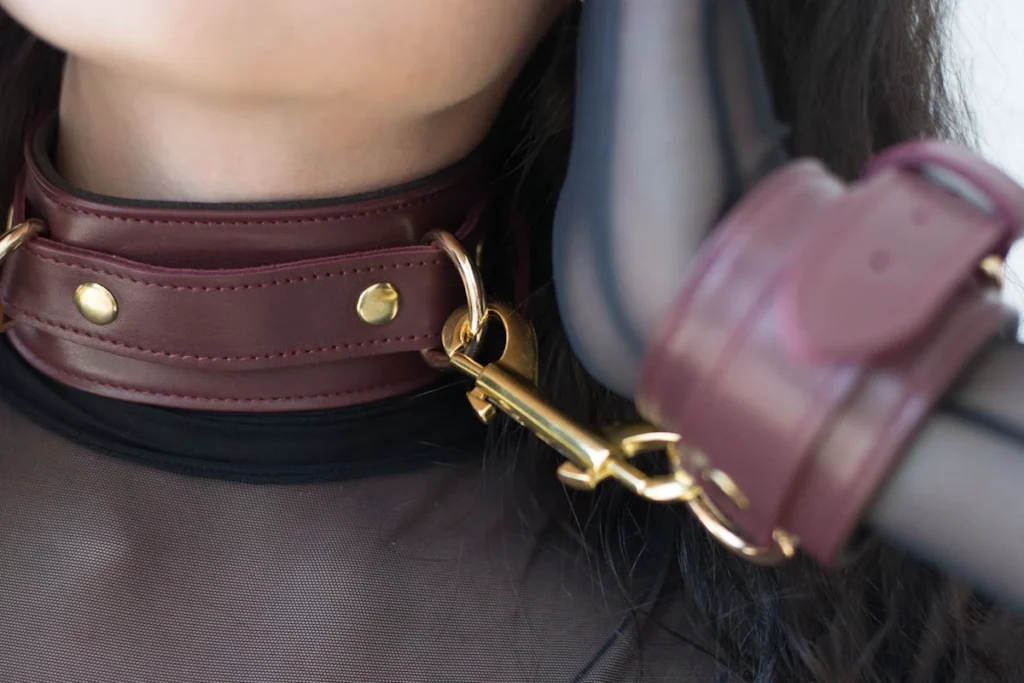
Look in the mirror. Tilt your head back. What do you see?
Anatomically, it is just a neck—a column of muscle, skin, and vertebrae connecting your head to your body. But psychologically? It is the most vulnerable expanse of skin you possess. It houses your breath, your blood supply, and your voice. To expose it is an instinctual act of trust. To allow someone to wrap a band of leather or steel around it is an act of profound surrender.
I have seen men tremble not because they were in pain, but because I fastened a lock around their throat. They realized in that singular moment that they no longer belonged solely to themselves.
Today, we are going to strip away the pop-culture misconceptions about “chokers” and delve into the true mechanics of the collar. This is not about fashion; it is about the Psychological Theater of ownership.
From Fashion to Fetish: The Evolution of the Neck Adornment
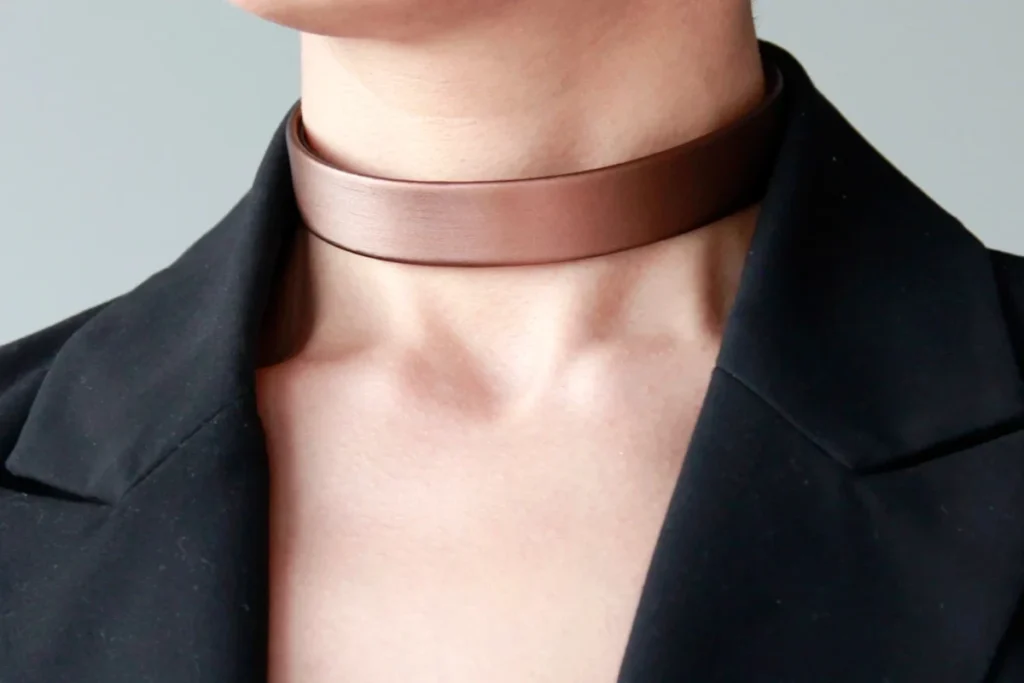
Walk into any high-street clothing store, and you will see racks of black velvet strips and faux-leather bands. The mainstream world calls them “chokers.” They wear them to look “edgy” or “alternative,” blissfully unaware of the signals they are broadcasting.
The Victorian Echo
This is not a new phenomenon. History is littered with women—and men—who understood the power of the neck. In the Victorian era, a simple velvet ribbon tied around the throat could signify anything from aristocratic mourning to a secret life as a courtesan. It was a code. It drew the eye to the bare skin, creating a contrast between the fabric and the flesh. It was the original esthetically engineered lure.
Modern Signals vs. True Meaning
In my line of work, we distinguish between a fashion statement and a statement of intent. When a “vanilla” person wears a choker, it is a decoration. When a submissive wears a collar, it is a badge of office.
The difference lies in the object’s transactional emotionality. For the uninitiated, it is an accessory. For those under my guidance, or in a D/s dynamic, that band around the neck carries the weight of a contract. It says: “I have voluntarily suspended my autonomy to serve a higher pleasure.”
The Typology of Control: Types of BDSM Collars Explained
If you are considering entering this world, or if you simply wish to understand the psychology behind the leather, you must know that not all collars are created equal. Each serves a specific function in the aesthetics of obedience.
The Posture Collar: The Art of Forced Elegance
This is my personal favorite for correcting a slouching spirit. A Posture Collar is typically wide, rigid, and reinforced—often made of heavy leather or even metal. It sits high on the neck, physically preventing the wearer from looking down.
Why is this effective? Because it forces the submissive into a state of perpetual, haughty elegance. You cannot hide your face. You cannot tuck your chin in shame or shyness. You are forced to present your throat to the room. It is a brilliant psychological tool because it turns vulnerability into a constant, unavoidable physical state. You are literally holding your head up high for your owner.
The Day Collar: A Whisper in a Crowded Room
Many of my clients are professionals—CEOs, lawyers, public figures. They cannot walk into a boardroom wearing a two-inch-thick studded strap. Enter the Day Collar.
So, what does a day collar mean? It is the art of discretion. It is usually a piece of fine jewelry—a silver chain, a specific locket, a locking anklet, or a subtle steel ring. To the outside world, it is just an ornament. But to the wearer, its weight is constant. Every time it brushes against the clavicle, it triggers a Pavlovian reminder of who they belong to. It allows the power dynamic to exist in public spaces, invisible to everyone but the two people involved in the transaction.
Pet Play & Functional Collars
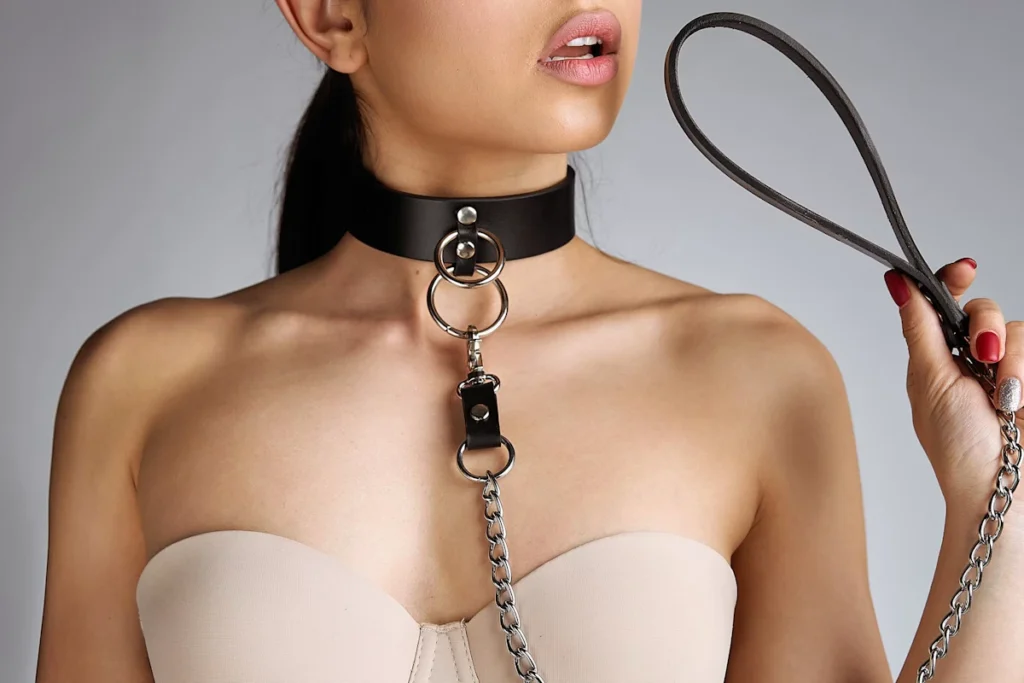
These are the workhorses of the fetish world. Usually made of durable leather with heavy D-rings, these collars are utilitarian. They are designed to be attached to a leash.
When I clip a lead onto a submissive’s collar, the dynamic shifts instantly. The human brain is simple; the sensation of being led by the neck bypasses higher logic and taps into something primal. It is the ultimate surrender of direction. You go where I pull. You stop when I hold. It simplifies life, and for many overthinking men, that simplicity is the ultimate luxury.
The Ritual of Collaring: A Transaction of Identity
You can buy a collar online. But you cannot buy the feeling of being collared. That must be earned.
The Moment of Locking
In my sessions, the most charged moment is not the exchange of money, nor the physical impact. It is the audible click of the lock.
Whether it is a small padlock or an Allen-key screw, that sound signifies crossing a threshold. It is a psychological seal. Before the lock clicks, you are a free agent discussing terms. After the click, you are property. The key stays with the Dominant. This asymmetry—one person holding the key, the other holding the weight—is the engine that drives the excitement.
Defining the Contract
We must be clear: this is Psychological Theater, not slavery. A collar without consent is just abuse. A collar with consent is art.
The “Collaring Ceremony” is a ritual where the rules are set. It represents a mutual agreement. The submissive agrees to offer their obedience and vulnerability, and in exchange, the Dominant agrees to provide structure, protection, and control. It is a fair trade. I give the cage; you provide the bird.
The Visual Aesthetics of Submission
Why do we find the collar so visually arresting? It ties deeply into the Neck Fetish psychology I often discuss.
Framing the Canvas
The neck is a canvas. A collar acts as a frame. By placing a dark band against pale skin, or a metallic ring against a tanned throat, you are highlighting the anatomy. You are drawing the eye to the Adam’s apple, the tendons, and the pulse point. A whisper, warm breath, and stimulation of nerve endings, which I wrote about earlier, determines how deeply the submissive partner will fall into this state.
It emphasizes the length and shape of the neck. For those with a fetish for the nape (the back of the neck), a collar accentuates that vulnerable curve where the spine meets the skull. It turns a body part into a focal point of desire.
The Look of Belonging
There is a primal satisfaction in seeing a marked territory. When a man walks into a room with a collar visible, he is signaling his unavailability. He is “taken” in the most absolute sense. For the Dominant, it is the satisfaction of seeing their taste displayed on another human being. It is the aesthetics of possession made manifest.
Material Matters: Safety and Selection
I do not tolerate sloppiness. If you are going to play with breath and blood flow, you must be educated. Ignorance is not sexy; it is dangerous.
Be careful when fastening tight collars if you’ve previously chosen to leave fresh marks of ownership on the neck. Irritated skin requires gentleness, and control should never be an excuse for sloppiness and unnecessary pain.
Leather, Metal, or Silicone?
The material dictates the sensation.
- Leather: Warms to the body temperature. It smells of tannins and skin. It becomes part of the wearer over time.
- Metal: Cold, unyielding, heavy. It provides a constant sensory reminder because it does not adjust to your movement.
- Silicone: Clinical, clean, often used for more intense sensory play or medical roleplay.
The Breath of Life: A Warning
Listen to me closely. The neck contains the carotid arteries and the windpipe. A collar is a symbol of control, not a weapon for execution.
- Size Matters: A collar should never be tight enough to restrict breathing or blood flow during normal wear. You should be able to slip two fingers comfortably between the leather and the skin.
- Anatomical Awareness: Never apply direct pressure to the trachea. The thrill comes from the feeling of restriction, not actual damage.
- Emergency Release: If you are playing with heavy bondage or locking collars, the Dominant must always have a method to cut or unlock the collar instantly in case of a medical emergency. Losing the key is not an option when safety is on the line.
The Final Lock
A collar is heavy. Not always in grams, but in significance.
It separates the tourists from the residents in the world of BDSM. Anyone can buy a piece of leather, but few have the courage to truly submit to what it represents. It is the physical manifestation of a psychological truth: that some of you find freedom only when you are bound.
I have explained the mechanism. I have shown you the types. I have warned you of the dangers. The only question remaining is not which collar you like, but whether you are brave enough to let someone else hold the key.
This is Miss Vex. Think about who owns you.

I am Miss Vex. I specialize in psychological control and the aesthetics of submission. My power lies in precision. Here, money is a vehicle for meaning. Welcome to my laboratory of desire—where your surrender becomes art.
Related Articles

Post Comments